


How to Build a MetaMask-Like Crypto Wallet From Scratch: Complete Guide
Share:
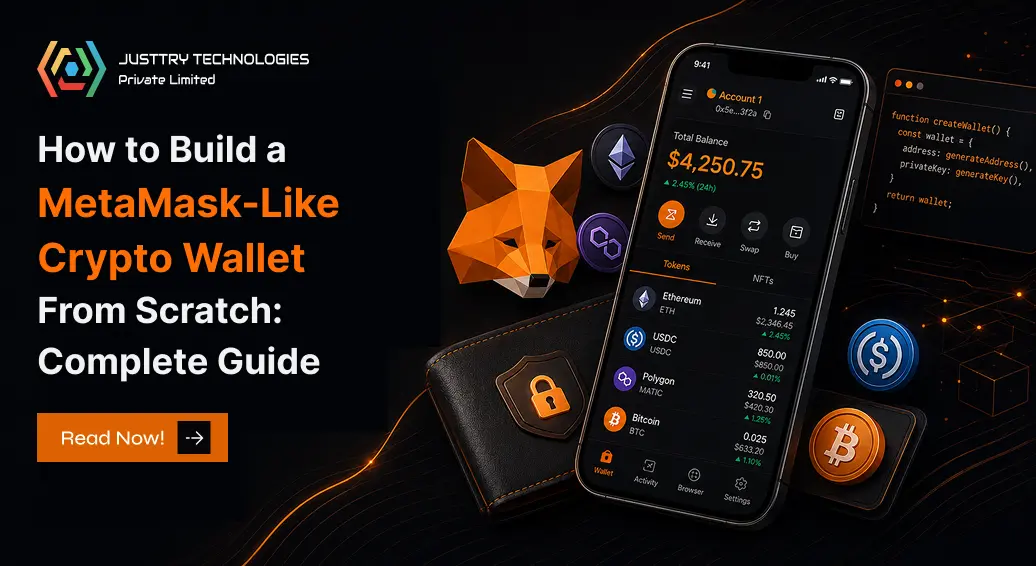
The demand for secure and user-friendly crypto wallets is growing with the rise of Web3. A wallet like MetaMask can do more than store digital assets; it can connect users with dApps, DeFi, NFTs, token swaps, and multiple blockchain networks. Building a MetaMask-like wallet helps businesses create a branded Web3 gateway with scalable features. This guide covers key features, technology, security, development process, cost, and timeline.
Why Build a Wallet Like MetaMask?
A non-custodial wallet gives users direct control over their private keys and digital assets. This model aligns closely with the principles of decentralization and gives businesses an opportunity to participate in the expanding Web3 economy.
A custom wallet can also be designed around a particular audience, such as traders, NFT users, DeFi participants, enterprises, or everyday crypto users.
The major advantages include:
- Direct interaction with blockchain networks
- Support for multiple digital assets
- dApp connectivity
- Token swapping capabilities
- Opportunities for transaction and service-based revenue
This makes crypto wallet development a strategic option for businesses seeking a stronger position in the Web3 ecosystem.
Key Features of a MetaMask-Like Wallet
A competitive wallet needs more than basic send-and-receive functionality. The user experience should feel straightforward even when the underlying blockchain operations are complex.
Important features can include:
- Multi-chain and multi-token support
- Secure wallet creation and import
- Real-time portfolio tracking
- QR-based transactions
- Built-in token swaps
- NFT management
- Transaction history
- Biometric authentication
- Backup and recovery options
A clean dashboard is equally important. Users should be able to understand their balances, transactions, and network activity without navigating through complicated screens.
Which Blockchain Should You Choose?
Blockchain selection directly affects wallet performance, transaction costs, scalability, and supported assets. Ethereum remains important, but modern wallets often extend beyond a single network.
Depending on the target audience, businesses can consider Ethereum, BNB Chain, Polygon, Solana, Avalanche, Arbitrum, Base, or other compatible networks.
The right choice depends on:
Target users: Which ecosystem do they already use?
Transaction costs: Are low-fee transactions important?
Asset compatibility: Which tokens and standards must be supported?
Scalability: Can the network handle expected transaction volume?
A multi-chain architecture can provide broader reach, but it also introduces additional development and security considerations.
Technology Stack for a MetaMask-Like Wallet
The technology stack should balance security, performance, maintainability, and scalability. Frontend applications can use React, React Native, or similar frameworks, while backend services may use Node.js or other scalable technologies.
Blockchain interaction can be implemented through tools such as Web3 libraries and RPC providers. Smart-contract functionality may rely on Solidity and audited contract components where required.
Crypto Wallet Technology should also incorporate encrypted key storage, secure authentication, transaction signing, monitoring, and robust API infrastructure.
How to Build a Wallet Like MetaMask?
The development process normally begins with business analysis and wallet architecture. The team then designs the interface, establishes blockchain connectivity, develops core wallet functions, integrates required APIs, and conducts extensive testing.
A practical development flow includes:
- Define the wallet's target audience and feature scope.
- Design the UX and technical architecture.
- Develop wallet creation, import, and transaction modules.
- Integrate selected blockchain networks.
- Add token, NFT, dApp, and swap functionality.
- Conduct security, performance, and compatibility testing.
- Deploy the wallet and continuously improve it.
The central principle behind How to build a wallet like MetaMask? is not copying the interface. It is recreating the underlying convenience while developing a wallet that delivers its own value proposition.
How to Integrate dApps and Token Swaps?
Connectivity via dApps will allow users to interact with such services from their wallets. Protocols like WalletConnect may be able to establish connections between wallets and compatible apps.
A token swap may be facilitated by using an aggregator or a protocol for liquidity. The wallet will show the user all the options for performing the swap, the output, fees, and the details of the transaction.
Transaction details are very important. The user should always know what he is signing.
How to Secure a MetaMask-Like Wallet?
It is important to look at security as a base that needs to be provided rather than a step that comes towards the end of development. The private key has to be secure, and any wallet data has to be encrypted.
A good security mechanism can include encryption, biometric authentication, signed transactions, phishing prevention, session control, and constant vulnerability testing.
Security audit by an independent organization prior to release to the public market can be very helpful. Even a tiny flaw in the wallet system can bring a lot of problems, and therefore security has to cover all layers of interaction with the blockchain.
How Much Does It Cost to Build?
It is dependent on the functions, blockchain compatibility, security, platforms used, and customizations. A simple wallet will be priced between $15,000-$30,000, whereas a high-end multi-chain wallet will be between $30,000-$60,000, and an enterprise wallet will be between $60,000-$100,000 and beyond.
The budget also varies with dApp and swap integrations, NFT support, security audits, UI/UX, backend infrastructure, and third-party APIs. A Metamask Wallet Clone Script can help reduce development time and initial costs while providing a customizable foundation.
How Long Does Development Take?
The development timeline for a MetaMask-like crypto wallet depends on its features, supported blockchain networks, integrations, and security requirements. A basic MVP wallet typically takes around 2–3 months, while a multi-chain wallet with advanced features such as token swaps, NFT support, and dApp connectivity can take 4–6 months. More complex, enterprise-grade wallets may require 9–12+ months.
Launch Your MetaMask-Like Wallet with Justtry Technologies
A successful Web3 wallet needs a combination of intuitive design, reliable blockchain infrastructure, strong security, and thoughtful functionality. Justtry Technologies can help businesses develop customized wallet solutions aligned with their target market, blockchain ecosystem, and long-term product strategy.
The objective should be bigger than launching another wallet. It should be about creating a dependable gateway through which users can securely manage assets, access decentralized applications, and participate in the evolving Web3 economy so, are you ready to build your own MetaMask-like wallet?
Frequently Asked Questions
Get in Touch
We're available to assist and address any inquiries you may have. We eagerly anticipate receiving your communication.